Your data can outlast your account by years
Privacy-policy wording from 5,000 website reports shows how long companies say they keep information, what you can ask them to delete, and where your data may go.
Close your account, and some of your information may remain on file for years. One privacy policy captured for a new CertScore.ai study says certain contract and transaction records are kept for ten years after a person’s last interaction.
The policy gives business and legal requirements as the reason. Read closely, the sentence is narrower than it first sounds. The clock runs from the last interaction, and the ten-year period applies to particular records. It is not a promise to delete everything when the account closes.
That passage was among 10,485 distinct policy excerpts identified in a study of 5,000 archived website reports. Across the 728 retention passages, 611 (84%) described conditions for keeping information without an explicit numeric period found in the captured wording.
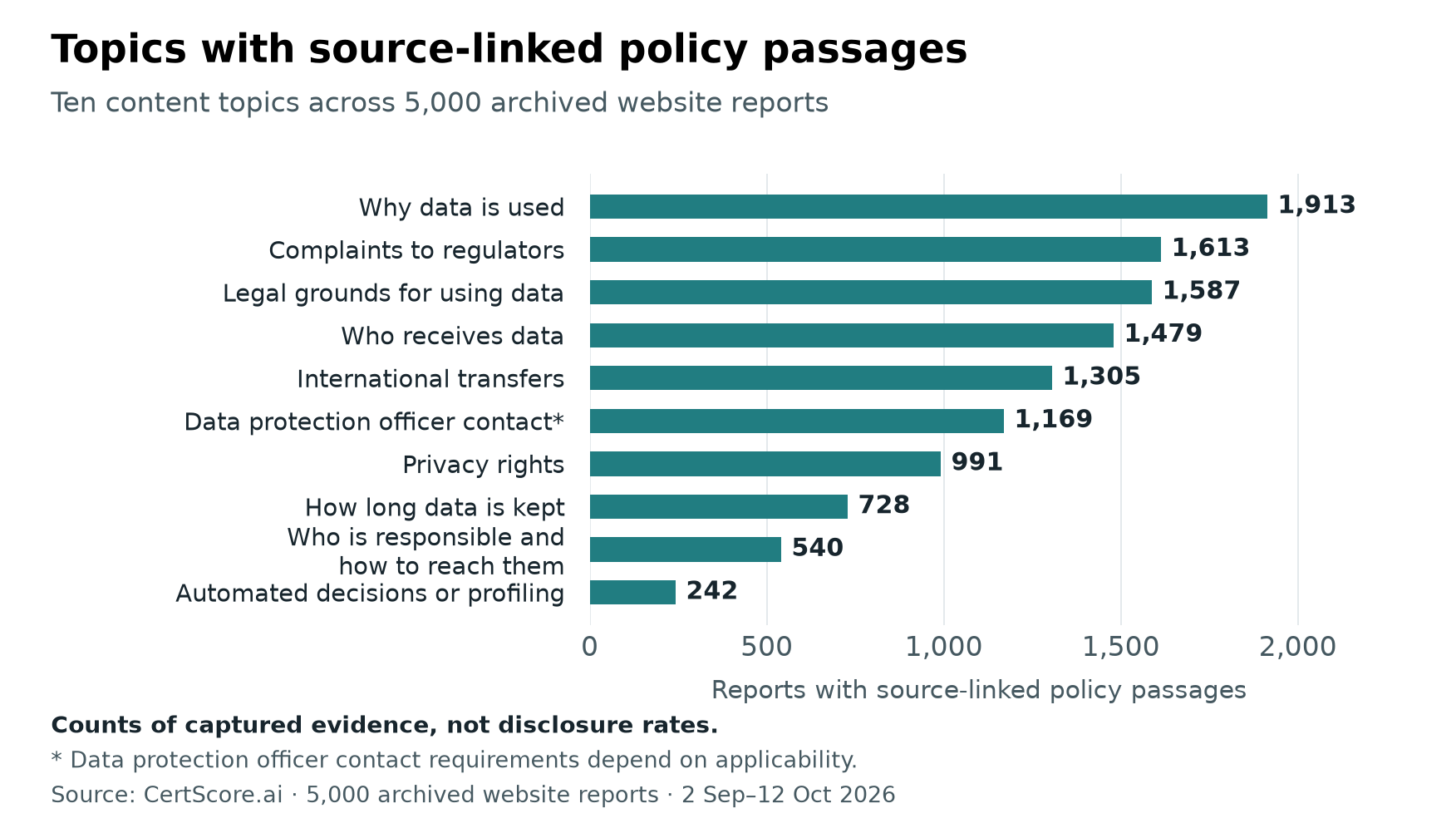
The study found source-linked passages about data retention in 728 reports, privacy rights in 991, and international transfers in 1,305. Another 1,913 contained passages explaining purposes for using personal information. Those figures count the evidence available for inspection. They do not tell us how many other policies contain the same disclosures.
Read the topic chart as a table
| Topic | Reports |
|---|---|
| Why data is used | 1,913 |
| Complaints to regulators | 1,613 |
| Legal grounds for using data | 1,587 |
| Who receives data | 1,479 |
| International transfers | 1,305 |
| Data protection officer contact* | 1,169 |
| Privacy rights | 991 |
| How long data is kept | 728 |
| Who is responsible and how to reach them | 540 |
| Automated decisions or profiling | 242 |
* DPO requirements depend on applicability, which this study did not adjudicate. Counts describe captured evidence, not disclosure rates.
How long policies say information is kept
The ten-year statement ties the period to particular records and a starting point:
Additionally, there is some personal information we need to retain even after you close your account to comply with business and legal requirements, such as personal information related to our contract and business transactions with you, which we retain for ten years after your last interaction with us.
Most of the retention passages took a different approach. In 611 of the 728 captured passages (84%), the analysis found conditions for keeping information but no explicit numeric period. For a reader, that shifts the question from “How many years?” to “What has to happen before this information is no longer needed?”
How the 728 retention passages break down
| What the passage describes | Passages |
|---|---|
| Conditions for keeping data, with no numeric period found | 611 |
| Gives an explicit numeric period | 70 |
| Says information may be kept indefinitely | 14 |
| Could not be classified | 33 |
| Total | 728 |
These are 728 passage occurrences, including repeated wording across reports. Each is assigned to one category. Two indefinite passages concern anonymized information. Unclassified wording does not mean a policy lacks a disclosure.
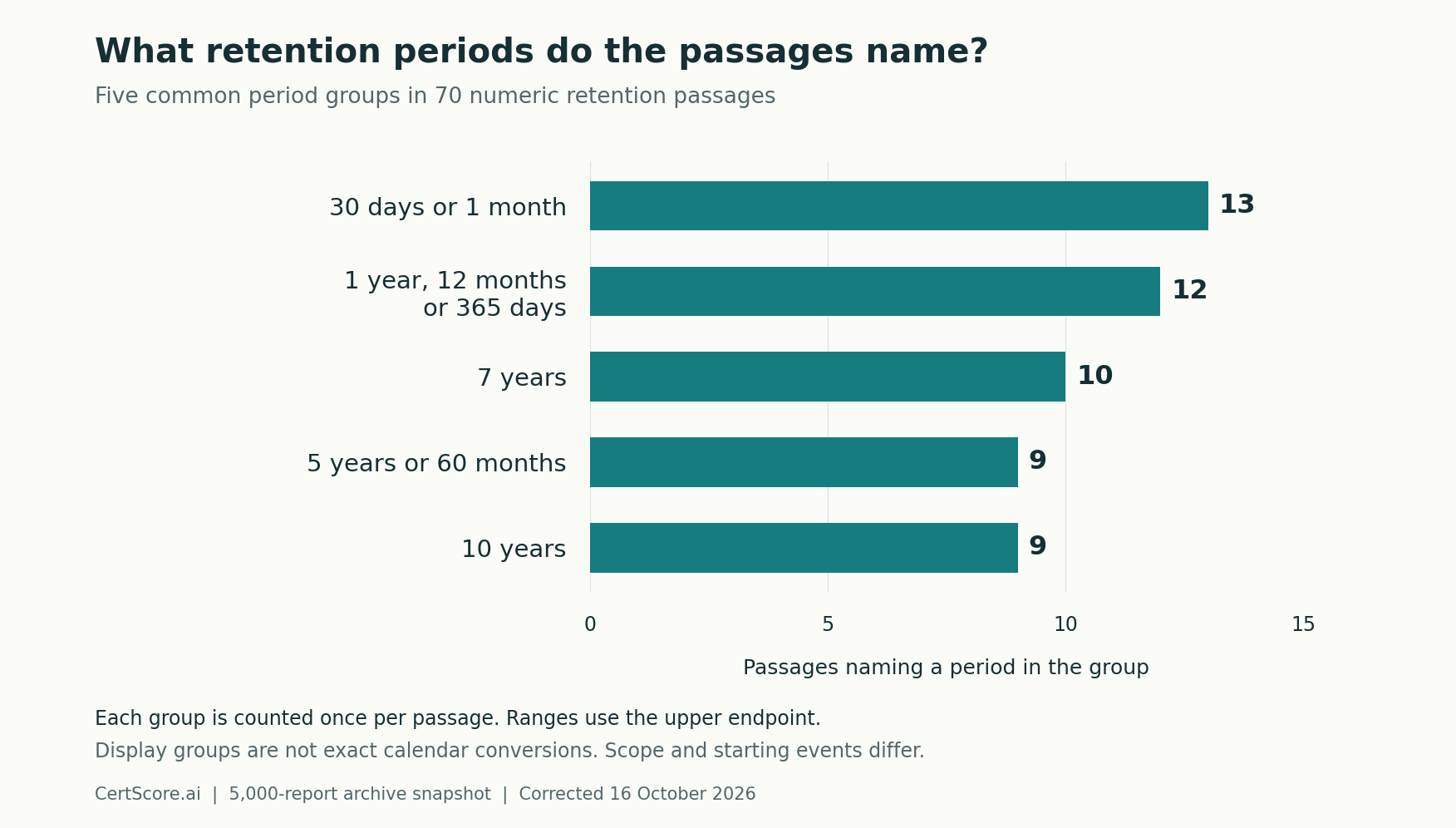
Where a number was found, the stated periods ranged from 14 days for logs to ten years for specified records. Grouping alternative expressions puts 30 days or one month first (13 passages), followed by one year, 12 months or 365 days (12), seven years (10), and five years or 60 months and ten years (nine each).
Read the period chart as a table
| Period group | Passages |
|---|---|
| 30 days or 1 month | 13 |
| 1 year, 12 months or 365 days | 12 |
| 7 years | 10 |
| 5 years or 60 months | 9 |
| 10 years | 9 |
These periods measure different things. Some concern storage, others deletion, anonymization or a move into an archive. A short period for logs says little about how long billing records might remain. A deadline for anonymization is different from a deadline for deletion.
What a policy gives you to work with
A policy can also tell someone where to start when they want a copy of their information or want it deleted. One passage in the study’s rights examples points to account settings and offers a contact route if those controls are unavailable:
The right to access, update or delete the information We have on You. Whenever made possible, you can access, update or request deletion of Your Personal Data directly within Your account settings section. If you are unable to perform these actions yourself, please contact Us to assist You. This also enables You to receive a copy of the Personal Data We hold about You.
The passage appears in a section about GDPR rights. Its “Whenever made possible” qualification matters: the account-settings route may not always be available. The study did not test either route, but the wording gives a reader a practical place to begin.
Other passages help readers work out what to ask a company. In one example, a policy names a safeguard for transfers to processors outside the European Economic Area:
If we transfer your personal data to third party processors outside of the EEA, we take legally required steps to ensure that appropriate safeguards, such as agreement to Standard Contractual Clauses are in place to protect your personal data.
That gives the reader something specific to follow up on: which transfers the statement covers and where the stated safeguards can be inspected. The conditional “If we transfer” does not establish that a transfer happened.
A fourth example describes possible uses of personal information:
We may use your personal information to administer surveys and other market research and for other research and development purposes, including to analyze and improve the Services and our business.
Here, someone can see that the stated purposes include research and service improvement, then ask which information is used for each. Each passage shows what a policy says, not what the company does.
Regulators are reading too
In March 2026, the European Data Protection Board announced that 25 European data protection authorities would examine transparency and information obligations through its 2026 coordinated enforcement action.
In the United States, California’s CCPA requires covered businesses’ privacy policies to explain consumer rights and how to exercise them. A 2022 California Attorney General settlement required a retailer to correct its policy to disclose that it sold personal information, alongside changes to its opt-out mechanisms.
In its 2024 guidance, the New York Attorney General reported finding 13 high-traffic websites whose privacy controls did not work as described. All the companies resolved the issues after being contacted. At the federal level, the FTC takes enforcement action over companies’ promises to safeguard personal information.
Those examples explain why accurate wording and working controls matter. They do not establish violations in this study, and the same legal duties do not apply to every website.
If you run a website, the same reading works in reverse: does your policy explain which records you keep and why, and does the deletion route it describes actually work?
CertScore.ai reports let you inspect retained policy wording, its source URL and capture time. Read the feature guide to find those passages in your report or retrieve them with a connected agent.
For the person closing an account, that might start with a simple question: which parts of my information stay after I leave?
Scan your own website
Start with a free scan of one public page. Enter your website URL to review the privacy-policy evidence and other signals CertScore.ai can observe.
Results describe the scan’s conditions and coverage.
About the study
CertScore.ai analyzed 5,000 archived reports completed between 2 September and 12 October 2026, selecting the latest eligible report per registrable website domain, then the 5,000 most recent domain representatives. Eligible reports had a completed or completed-limited scan, an identified privacy-policy page, all 11 transparency results, retained wording and recorded source details. Sites can share policies, so this is not a count of 5,000 unique policies. Each counted passage had to be linked to its source page and pass topic-specific text checks. “Distinct” means exact excerpt text, preserving capitalization and punctuation, after trimming surrounding whitespace. It is not a representative sample of the web and does not establish disclosure rates or legal compliance. Non-English text is likely under-counted; retention categories cover English wording only. A period not found in a retained passage may appear elsewhere in the full policy.
All four examples came from policy captures dated 12 October 2026. Website names are omitted, but the exact quotations remain searchable and may identify their sources. Those selected reports retrieved their policy evidence on that date. The study reused archived evidence rather than visiting the sites again. CertScore.ai conducted the research using its own product data and has a commercial interest in the product.
Read the methods and aggregate tables for eligibility, counting rules and the bounded retention validation.
Researchers and journalists can email [email protected] to request aggregate tables or ask about the methodology. Please mention “Privacy Policy Transparency Study.”
Methods and aggregate tables
Correction, 16 October 2026: A retention schedule under a heading used noun phrases rather than a same-sentence storage verb. It was initially counted as criteria-only. Rechecking the retained wording changes criteria-only passages from 612 to 611 and numeric passages from 69 to 70, and adds four stated periods. The chart now groups alternative expressions of common periods. The 728 retention passages and all topic totals are unchanged.
Read selection rules, counting definitions and retention validation
This supplement describes the frozen evidence behind the article Your data can outlast your account by years. It measures captured policy wording in an archive cohort, rather than disclosure prevalence or legal compliance.
Selecting the reports
The archive inventory froze on 12 October 2026 at 19:23:12 UTC with 40,297 unique report files. Eligibility yielded 15,561 reports covering 8,217 registrable report domains. The analysis chose the latest eligible report per domain and then the 5,000 most recent domain representatives, breaking time ties by scan identifier. Selected reports completed between 2 September and 12 October 2026.
Eligible exports had a valid completion time at or before the cutoff; completed or completed-limited status; an explicit privacy-policy surface; all 11 canonical transparency rows without conflicting aliases; at least one content excerpt; at least one content row with a source URL, retrieval timestamp and recorded controller or first-party-brand relationship; and a report projection hash. Excerpts and source details could occur on different rows at this selection stage. The counted positive evidence required them together. Internal product and reserved test, example and localhost domains were excluded. No positive result for a particular content topic was required.
The domain unit uses public-suffix-aware normalization with private suffixes enabled. It is not a verified census of companies or destination domains. Reports can share policies: grouping by each report’s primary attributed policy-source URL produced 4,842 URL groups. These are URL groups, not verified unique policy documents.
Counting the evidence
Each report contributes one availability result and ten content-topic results: 55,000 check results, of which 50,000 concern content. A result is not necessarily a positive observation. Policy availability is a cohort condition, so it is separate from the ten plotted content counts. A separate cookie-disclosure row in the product’s Policies & disclosures section is outside these 11 privacy-policy checks.
| Evidence measure | Count |
|---|---|
| Stored content rows marked Observed | 23,451 |
| Those rows with excerpts and source attribution | 17,588 |
| Those rows passing the topic text screen | 11,567 |
| Reports contributing at least one screened row | 3,528 |
| Exact unique screened excerpt texts | 10,485 |
The text screen applies topic-specific rules to retained excerpts. Counted rows had a stored Observed status, a nonempty excerpt, source URL, retrieval timestamp and recorded controller or first-party-brand relationship, plus wording accepted by the topic screen. Passing the screen does not establish legal adequacy or underlying practices. Nonpassing or unresolved rows do not establish absent disclosures.
Of the 5,000 eligible reports, 1,472 contributed no screened content row. Of 17,588 source-attributed Observed rows, 6,021 did not pass the study’s text-only topic screen. The table below separates those results by topic. These are retrospective research exclusions, not a measured product false-positive rate.
| Topic | Starting rows | Excluded | Passed |
|---|---|---|---|
| Why data is used | 2,569 | 656 | 1,913 |
| Complaints to regulators | 2,014 | 401 | 1,613 |
| Legal grounds for using data | 1,986 | 399 | 1,587 |
| Who receives data | 2,397 | 918 | 1,479 |
| International transfers | 1,707 | 402 | 1,305 |
| Data protection officer contact | 1,393 | 224 | 1,169 |
| Privacy rights | 2,148 | 1,157 | 991 |
| How long data is kept | 1,928 | 1,200 | 728 |
| Who is responsible and how to reach them | 920 | 380 | 540 |
| Automated decisions or profiling | 526 | 284 | 242 |
Exclusions were primarily insufficient topic-specific terms (5,973 rows). Other recorded reasons were generic storage wording without retention meaning (20), low-confidence or ambiguous wording (13), code or non-policy excerpts (9), and page chrome or navigation (6). The screen assigns one recorded reason to each excluded row; an exclusion does not establish that the policy lacks the disclosure.
The product uses shared topic-rejection rules within a broader projection that also checks language, context, source binding and provenance. This study reapplied the frozen retained-report text screen to historical exports from projection versions v24, v26 and v27. That retrospective screen is not a claim that every historical Observed row or every current production path uses an identical text-only test. The study preserves the original report labels.
There is one row per topic per report, and one accepted excerpt per counted row in this cohort. Topic totals therefore count reports with screened evidence. Summing them gives 11,567 report-topic entries; the same wording can recur across reports or topics. Distinct means exact excerpt text after removing the Excerpt: prefix and trimming surrounding whitespace. Capitalization, punctuation and internal whitespace remain significant. It does not mean distinct organizations or independently written policies.
The controller/contact screen retained 540 of 920 source-attributed rows. The 380 excluded excerpts lacked the required topic-specific terms; none were rejected as navigation. Counts for contact, DPO and complaints use different rules and starting rows and are not nested measures of policy completeness. DPO requirements depend on applicability, which this study did not adjudicate.
The ten screened content counts appear in the article chart. Privacy availability records 5,000 as a selection condition.
Retention coding and its limits
The 728 retention rows contain 728 passage occurrences and 676 exact unique texts. English-language rules identify number words or digits with days, months or years in retention-related sentences, with heading-bound schedule review, then classify numeric periods, criteria without an extracted numeric period, indefinite wording, or unresolved wording. Review-cadence intervals are excluded, and permanent deletion does not mean indefinite retention. Duplicate passages across reports remain in the occurrence counts. A separate search of all 728 excerpts found no retention periods expressed in weeks, hours, minutes or seconds; the only time-unit-like matches were two postal-address references to “Second Floor.”
| Final category | Passage occurrences |
|---|---|
| Criteria without an extracted numeric period | 611 |
| Explicit numeric period in retention-related wording | 70 |
| Indefinite wording | 14 |
| Unresolved wording | 33 |
| Total | 728 |
The 70 numeric occurrences contain 67 exact unique texts. Numeric periods can describe storage, deletion, anonymization or archiving rather than a complete policy-wide retention limit. Two indefinite passages concern anonymized information. The 611 criteria-only occurrences are 83.93% of the 728 occurrences; that percentage describes passages, not websites generally.
Seven corrections bound to the retained excerpt hashes reconciled category edge cases. A separate correction restored an omitted nine-month period in wording specifying nine and eighteen months respectively. That correction left the category counts, extrema and leading frequencies unchanged. The private ledger retains the original output, correction and rationale; historical production findings were not changed.
After 200 development-sample passages and separate review of numeric candidates, the frozen rules were checked against a further random sample of 50 from 413 eligible occurrences, excluding previously inspected exact text. Validation completed on 12 October 2026. Seed 20261016 is an arbitrary reproducibility integer, not a date. The sample contained 46 criteria-only, two indefinite and two unresolved passages, with zero category or numeric-period disagreements. It contained no numeric-period passages, so it does not measure numeric-extraction accuracy on unseen positives or general accuracy across the corpus. The nine-month correction and the 16 October heading-bound schedule correction are separate from that frozen-rule check. All 70 numeric passages were rechecked against their retained excerpts for this update; this is an editorial extraction review, not independent human validation or a check of original policy pages.
Value frequencies count each value/unit once per passage. Ranges use the upper endpoint. Day equivalents order endpoints only; units otherwise remain as written. Scope and starting events are left unknown when the retained fragment does not provide them. A passage without an extracted period does not establish that the full policy lacks one.
| Period as recorded | Passage occurrences |
|---|---|
| 30 days | 12 |
| 7 years | 10 |
| 10 years | 9 |
| 1 year | 8 |
| 5 years | 8 |
| 3 years | 5 |
| 2 years | 4 |
| 6 years | 4 |
| 2 months | 3 |
| 12 months | 3 |
| 24 months | 3 |
| 90 days | 3 |
| 6 months | 2 |
| 1 month | 1 |
| 3 months | 1 |
| 9 months | 1 |
| 14 days | 1 |
| 18 months | 1 |
| 45 days | 1 |
| 60 days | 1 |
| 60 months | 1 |
| 180 days | 1 |
| 365 days | 1 |
What the study can support
The cohort is a recency-selected, non-probability snapshot. It is not representative of the web, and repeated policies and multiple topics are not independent observations. No trend, compliance ranking, confidence interval or population estimate is inferred. Non-English text is likely under-counted across topics; retention coding covers English wording only. The checks are not an exhaustive statement of US or EU law.
The analysis preserved historical report labels and reused exports from projection versions v24, v26 and v27. It did not recrawl websites or establish that the wording remains current. Selected export bytes were checked against the archive’s recorded checksums before extraction. Export checksums bind report bytes; they do not authenticate original policy-document bytes.
The four featured examples were selected to illustrate retention, rights, transfers and purposes, rather than as a random sample or endorsements. Their exact quotations, punctuation and capitalization match the retained excerpts. Their recorded policy-retrieval times are on 12 October 2026 UTC. Names are omitted; searchable quotations may still identify their sources. The source mapping and row-level evidence remain private.
CertScore.ai conducted this research using its own product data and has a commercial interest in the product. The regulatory sources provide context rather than findings about the sampled websites. Researchers and journalists can email [email protected] with “Privacy Policy Transparency Study” to request aggregate tables or ask about the methodology.